I often say to students that poetry is “mostly a voice”–and for most poems this statement is true. I guess I should add that a poem is “mostly a voice contemplating something“–emphasis on the “thing.”
A poem might be as simple as a woman meditating on whether or not she should chop down the black walnut tree looming over her house (Mary Oliver’s “Black Walnut Tree”) or Emily Dickinson just strolling through her yard thinking about autumn (“The morns are meeker than they were”).
A misnomer about poetry though is that a poem is ONLY a voice. To me, poems worth reading are not airy, philosophical fancies or intellectual castles in the air. Poems worth reading are about the earth, about the material world. Auden says that the first job of a poem is to praise what is–to which I can only respond, “Amen.”
I am not interested in poems that read something like this:
Love is beautiful–
Love is kind.
Love makes me
Loose my mind
Angels and ministers of grace defend us from such poetry.
All you have to say is . . .
My love is a red, red rose
And I’m immediately interested. A rose has entered the chat. A real, honest to God, smellable, cuttable, touchable, rose. And I then wonder, “Hmm. How is love like a rose?”
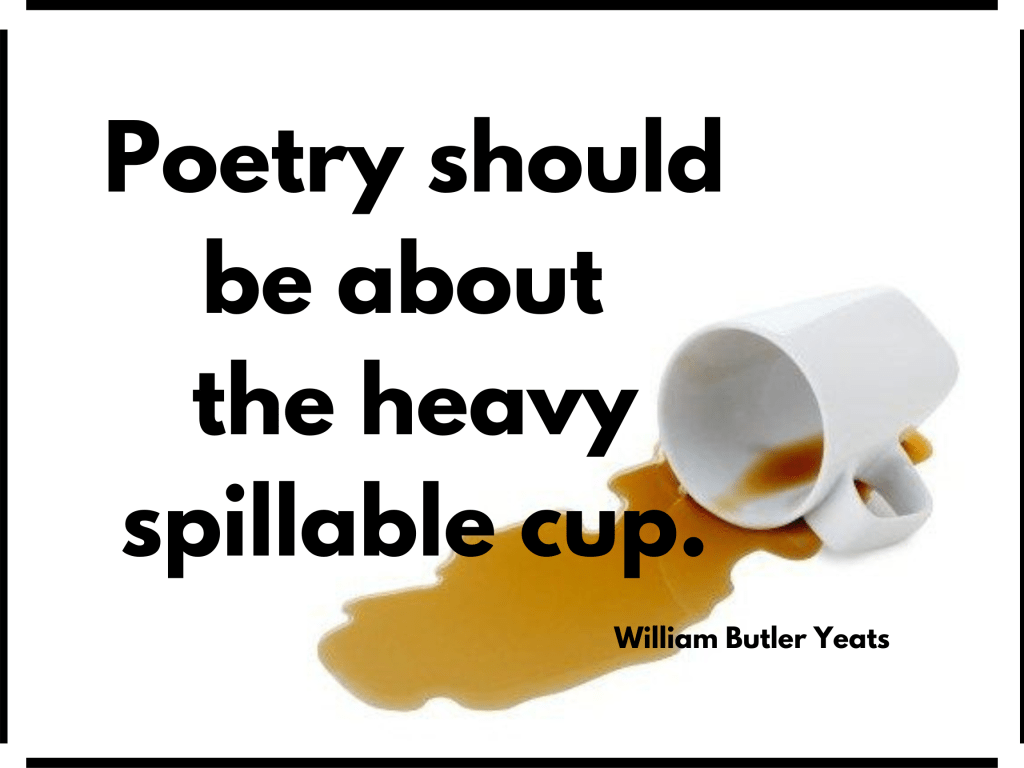
Yeats said–somewhere–that poetry should be about the “heavy, spillable cup”–and how I love that word “spillable” which makes that cup so alive to me.
In his poem, “Birches,” Robert Frost depicts a kid who likes to climb young birch trees. He starts on the ground and climbs up to the heavens. And when the boy’s weight gets too heavy and the tree bends downward, the boy leaps off back on earth.
This upward from earth, downward from heaven movement has been described as exactly how a poem should work. You start with the earth, climb up high to some spiritual, intellectual, emotional thought–and maybe you end there or maybe you end back on earth since “Earth’s the right place for love.”
One of the best questions an English teacher can ask always starts with the material subject of the poem: “This poem is about climbing birch trees, but it is also about . . .”
Whatever completes that sentence is where the poem really is.
 Wild Surmise
Leave a comment