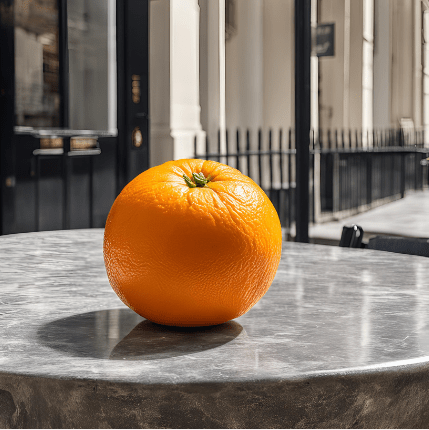
“At lunchtime, I bought a huge orange.”
Wendy Cope’s three quatrain poem, “The Orange” begins innocuously enough, with Yeats’ “heavy spillable cup”—in this case, an over-sized orange. And yet, just eleven lines later, the poem ends with a powerful yet understated affirmation of both love of another person and love of one’s self and one’s existence. That’s quite a journey for a 12 line poem.
So much to praise about this poem! First of all, we have to appreciate its perfect ballad meter and rhyme scheme. “Orange,” of course, famously doesn’t rhyme with anything, and so Cope tosses it off as the end of line 1 (since only the 2nd and 4th lines rhyme, Cope gets two “freebies” each stanza). But how satisfying is rhyme—especially in a love poem? Cope’s last rhymes (“list” and “exist”) are perfect—the only rhymes to top it would be “persist” and “kiss” in Kim Addonizio’s “First Poem” for you. The meter and rhymes roll off the tongue and make the poem easy to memorize and a delight to recite.
And the friendliness of that opening! The speaker bought—not just any orange—but a HUGE orange. It’s so big that it makes all her friends laugh. Like a lot of great poems, we get to fill in the blanks here with what might have gone down: “Wow, Wendy, that orange is, um, really big.” “Girl, that is the biggest orange I’ve ever seen!” “Are you hungry, Wendy?” The idea of co-workers, Robert and Dave, teasing the speaker about her orange creates a bright spot in a workday. I tend to tell students that I imagine the speaker as doomed by her job to be in a cubicle all day in some skyscraper in London—and that all the workers have come down to the street to get some sunshine and buy lunch—including an orange—from the street-vendors all around. The orange brings some brightness and citrus-energy to otherwise drab, office-gray day.
And hey, there’s enough orange to go around! The generosity of the speaker sharing quarters of the huge orange with Robert and Dave is a bonus in the poem—there’s enough joy for all!
The second stanza gets reflective after the action scene of stanza one: “And that orange, it made me so happy.” The speaker marvels at how—somehow—her life has changed subtly over some time now without her consciously noticing it. She hadn’t realized it or thought about it—but that orange, and—come to think of it—all sorts of ordinary things had been bringing her joy: “The shopping. A walk in the park.”
Like the speaker in Jane Kenyon’s “The Suitor,” she suddenly realizes that things have been changing for the better for her, that she’s actually (shock) happy: “This is peace and contentment.”
Then–in just two words–Cope reveals how profound this change of life-outlook is for her speaker: “It’s new.”
Again, we fill in the blanks and wonder what life was like before ordinary things started giving the speaker joy. How sad was she? How lost? And for how long? Whatever the answers to these questions, it wasn’t a good time before.
In the third stanza, Cope piles on so much “ordinary” happiness that it almost becomes unbelievable. The speaker had an easy day (what?). She did ALL the jobs on her list (you’re kidding! That never happens). And she enjoyed all those jobs (impossible)—and had time left over (gimme a break). The list of good moments reaches the point of impossibility—and then the poem concludes with two breath-taking assertions:
First, “I love you.” Wait. What? This was a love poem addressed to someone? This poem about an orange eaten during a lunchbreak at work? But yes, it is. The speaker loves someone and is sharing her realization of that joy. “I love you” and then–the surprising last line–“I’m glad I exist.”
Not I’m glad “you” exist, which we would ordinarily expect in a traditionalish love poem—but I’m glad “I” exist. The speaker’s dark days of the past were evidently much darker than we could guess, possibly even depressed or suicidal.
But those days are no more. Somehow the dismal time has faded and now the whole world is lit up like—well, like an orange.
Just marvelous—and, with only a very few contenders for the title—the happiest poem I know.
 Wild Surmise
Leave a comment